https://www.straitstimes.com/world/united-states/baltimore-bridge-collapse-shipowners-seek-to-limit-liability-could-dirty-fuel-have-played-a-role
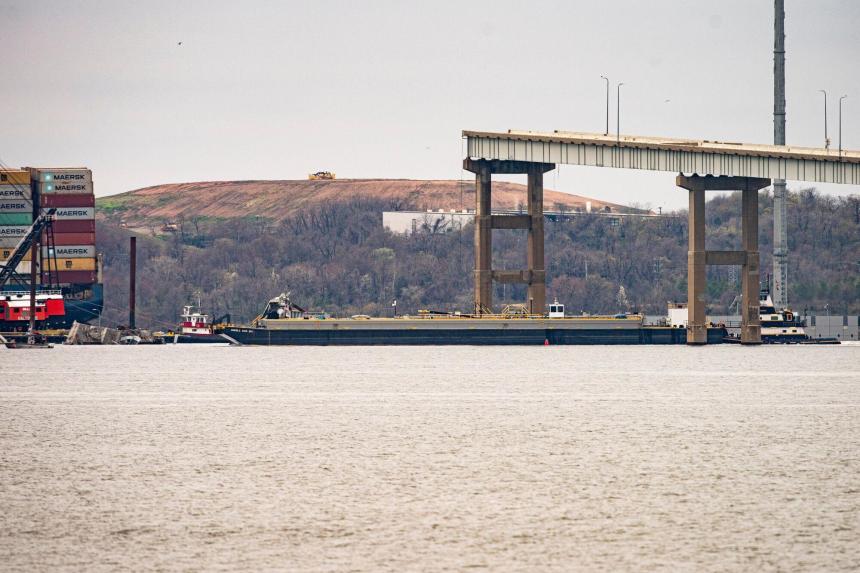
A fuel barge is pushed by Tugboat Crystal Coast, the first vessel to transit a new temporary alternate channel near the Dali container vessel.
BALTIMORE – The two Singapore-based companies that own and manage the container ship that knocked down the Francis Scott Key Bridge in Baltimore, in which six lives were lost, have asked a court to excuse them from any liability for the March 26 disaster.
In a petition filed on April 1 before a federal court in the state of Maryland, in which Baltimore is located, the companies said the collapse of the bridge was “not due to any fault, neglect, or want of care”, and sought not to be held liable for any loss or damage resulting from the disaster.
But in the event that they are held liable, they asked that the judge limit the damages to around US$44 million (S$59 million), the current value of the ship and its cargo minus the damage and salvaging cost.
The petition was filed by Grace Ocean that owns Dali – the container ship that slammed into the bridge – and Synergy Marine, which manages it. Both are incorporated and registered in Singapore.
Recounting the March 26 incident, the petition said that the Sri Lanka-bound ship, whose final destination was Yantian in China, had entered the shipping channel at about 1.08am local time.
Seven to 10 minutes later, the ship, which was hauling 4,679 containers of cargo, experienced a loss of power and propulsion.
“The vessel made efforts to regain power, which occurred briefly, but power was lost a second time shortly thereafter. The vessel drifted to starboard, then dropped anchor in response to the loss of power and propulsion,” the petition said. The collision with the bridge occurred at 1.28 am, it added. It did not detail how the crew reacted in response to the unfolding disaster.
The ship, along with its crew of 22 Indian nationals, remains stranded in the Patapsco River. Huge chunks of the bridge, weighing up to 4,000 tons, collapsed on its deck.
A Bloomberg news report characterised the legal move as a common practice by ship owners to reduce liability after catastrophic crashes.
Any claimant suing the Dali owners to recover funds beyond the liability limit would likely have to show that the ship was not seaworthy due to issues such as an incompetent crew or mechanical issues, the report added.
Insurance claims, covering the loss of the bridge and the disruption of businesses using the port, may run into billions of dollars.
The bridge was built in 1977 at a cost of more than US$60 million – or around US$300 million at today’s prices, adjusted for inflation.
Victims of the crash could also file claims against the ship operator.
The petition did not say who the companies believed was responsible for the crash, which is being investigated by the National Transportation Safety Board.